Category: Grief and Loss

Grieving the Death of a Parent

Written by: Michael Marsteller, MA, NCC

Greiving Parents

The death of a parent is one of life’s most profound losses. Whether it happens in childhood or adulthood, it often changes us in ways we never expected.

When a parent dies, we aren’t only grieving the person we lost. We are also grieving the relationship we shared, the role they played in our lives, and the future we imagined together. We may miss their guidance, the traditions we shared, or simply knowing they were there.

Because of this, grieving the death of a parent often touches every part of our lives.

Grief Looks Different for Everyone

Grief doesn’t follow a predictable timeline, and it rarely looks the way we expect.

Some people feel overwhelmed by sadness, while others feel numb or disconnected. Some experience relief after a parent’s long illness and later feel guilty for that relief. Others don’t fully feel the loss until months or even years later. All of these responses can be part of grief.

Grieving and Healing

The relationship you had with your parent also shapes how you grieve. If your relationship was loving and supportive, you may deeply miss that source of comfort and security. If the relationship was complicated, distant, or painful, grief may include anger, regret, relief, or all of these at once. No two parent-child relationships are exactly alike, and no two grief journeys will be either.

Grief has room for mixed emotions.

How the Death of a Parent Can Affect Us

The loss of a parent can reach far beyond the initial weeks and months after their death. You might notice:

  • Feeling less grounded in the world
  • Numbness or emotional disconnection
  • A heightened awareness of your own mortality
  • Missing the person you would normally turn to for guidance or reassurance
  • Feeling alone during milestones, holidays, or family gatherings
  • Changes in your sense of identity or your role within the family
  • Waves of grief that return unexpectedly, even years later

These experiences don’t necessarily mean something is wrong. They often reflect the significance of the relationship and the many ways it shaped your life.

Interested in Therapy Options?

Schedule a Free Intake Online with our Intake Coordinator. We can help walk you through all options and answer any questions you may have.

Healing Doesn’t Mean Leaving Them Behind

One of the most common fears people have is that healing somehow means forgetting the person they loved or “moving on.”

Grief and Loss

In reality, healing isn’t about letting go of your parent. It’s about learning how to carry their memory while continuing to live your own life.

Over time, many people find meaningful ways to stay connected to their parent’s memory, such as:

  • Telling family stories
  • Cooking a favorite recipe
  • Carrying forward values your parent taught you
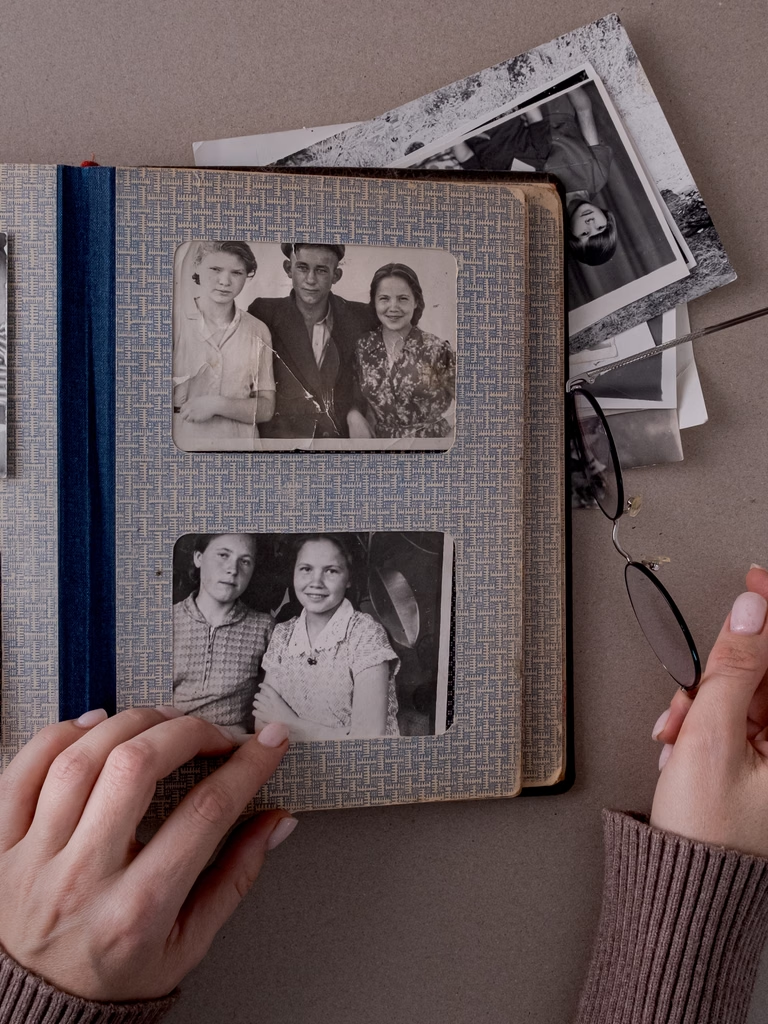
  • Looking through old photographs
  • Talking to them in your thoughts

Love doesn’t end when someone dies, and neither does the bond we shared with them.

While the bond may change over time, it doesn’t have to disappear.

Giving Yourself Permission to Grieve

Our culture often expects grief to follow a timeline: a few weeks of mourning, then a gradual return to normal. But grief doesn’t work that way.

There is no deadline for missing someone who mattered deeply.

Grief and Healing

Healing often begins when we give ourselves permission to experience our grief rather than judge it. It means allowing space for sadness, remembering with compassion, and recognizing that grief can coexist with moments of joy, laughter, and hope.

If you’ve lost a parent and find yourself wondering why the grief still feels present months or even years later, know that you are not alone. Grief doesn’t disappear because time has passed. Instead, it changes as we change.

How has the loss of your parent continued to shape your life?

If you’re ready to explore that question, therapy can provide a place to honor that relationship, process the many layers of your loss, and discover ways to move forward without leaving your loved one behind. Healing doesn’t mean forgetting. It means learning to carry your grief with greater compassion, resilience, and hope.

Interested in Therapy Options?

Schedule a Free Intake Online with our Intake Coordinator. We can help walk you through all options and answer any questions you may have.

Mike Marsteller, Clinical Intern, Low-Cost Trauma Therapy at The Phoenix Center near Philadelphia

Learn More about Michael Marsteller, Experiential Trauma Therapist

How Childhood Loss Can Show Up in Adulthood

Written by: Michael Marsteller, MA,  NCC, LAPC

Grief Isn’t Always About Death

When we think about grief and loss, we often think about the death of someone we love. While that is certainly one form of grief, it’s not the only one. Many of us experienced childhood loss that was never recognized as grief. These losses can take many forms, including:

Childhood loss and ambiguous losses
  • A parent’s divorce or separation
  • The death of a grandparent or another important caregiver
  • Moving away from friends, family, or familiar surroundings
  • Growing up with a parent or family member struggling with addiction
  • Emotional neglect or inconsistent care-giving
  • Living with chronic illness
  • Bullying or peer rejection
  • Growing up in an unpredictable or unsafe home
  • The loss of safety, stability, or innocence
  • The childhood you needed but never had

While each of these experiences is different, they can all represent meaningful losses that deserve to be acknowledged. Many of them can involve ambiguous loss—a loss that is real and deeply impactful, but often lacks clear closure or social recognition. Because these losses aren’t always acknowledged as grief, we may carry their effects without realizing we’re grieving in the first place.

Although these losses happened in childhood, they don’t always stay in the past. They can influence how we experience relationships, respond to conflict, view ourselves, and even what feels safe or familiar. The ways we learned to seek comfort, protect ourselves, or connect with others in childhood often become the blueprint for our relationships in adulthood. Instead of asking, “What’s wrong with me?” we can begin asking, “What happened to me?”

How Children Adapt to Loss

As children, we often don’t have the language or emotional capacity to make sense of our losses. Instead of grieving them, we adapt.

how children adapt to loss

Many of us learn to become independent because asking for help didn’t feel safe. We may become the “responsible one” because someone had to hold things together. Some of us will learn to people-please in an effort to avoid conflict or rejection. We stay emotionally guarded because vulnerability once led to disappointment.

These adaptations are often incredibly resourceful. They helped us survive difficult circumstances.

When Childhood Survival Strategies Follow Us Into Adulthood

The challenge is that the strategies that once protected us can begin to limit us. What helped us survive childhood may make it difficult to trust others, ask for help, or believe we’re worthy of care as adults.

These unresolved losses can show up in ways we don’t immediately recognize. For example, you might notice:

  • Difficulty trusting others or asking for help
  • Fear of abandonment or rejection
  • Feeling responsible for other people’s emotions
  • Believing you have to earn love through achievement or care taking
  • A persistent sense that something is missing, even when life appears to be going well
Childhood loss and impacts into adulthood

This doesn’t mean that every struggle in adulthood is rooted in childhood grief and loss. The human experience is complex, and there are many reasons people may experience anxiety, depression, relationship difficulties, or low self-worth. But for some people, early losses are an important part of the story, especially when those losses were never acknowledged or processed.

Healing Begins by Acknowledging What Was Lost

One of the most powerful aspects of therapy is having a safe space where you can finally acknowledge those losses with compassion. Grieving isn’t about staying stuck in the past. Instead, you can honor what was lost, recognize how those experiences shaped you, and allow yourself to respond with the care and understanding you may not have received at the time.

Healing doesn’t mean forgetting the past or pretending those losses didn’t happen. Rather, it means making space for those experiences to be acknowledged, understood, and integrated so they no longer have to define how we relate to ourselves and others.

Looking at Your Story with Compassion

Childhood Loss and Compassion

When we begin to grieve what was missing—not only who or what we lost, but what we needed and never had—we often discover that through healing we can move forward with greater freedom, self-compassion, and deeper connection to ourselves and others.

If you’ve ever wondered why certain relationship patterns, emotional reactions, or beliefs about yourself seem so difficult to change, it may be worth considering whether there are losses in your story that never had the opportunity to be grieved. Recognizing those losses does not change the past, but it can change the way you understand yourself, and that understanding can become the foundation for meaningful healing.

What childhood loss in your own story may have never been recognized as grief?

If this resonates with you, you’re not alone. Therapy can provide a space to explore these experiences with curiosity and compassion, helping you understand how the past continues to shape the present while supporting meaningful change.

About the Author: Michael Marsteller

Michael Marsteller

Mike Marsteller, MA, NCC, LAPC (he/him/his), has earned his Master’s in Clinical Mental Health Counseling from Messiah University and works with adults navigating trauma, grief, and bereavement, with a particular focus on attachment and early relational trauma.

Mike is especially passionate about helping clients process childhood trauma, navigate grief and loss, and break inter-generational patterns that continue to impact their lives and relationships. Drawing from his experience as a certified grief educator and facilitator of grief support groups for adults and children, he offers a space where grief can be witnessed, honored, and gradually made sense of without pressure to rush the process.

8 Types of Grief: Healing from Loss

Grief is a universal experience, yet it manifests in various ways, influenced by individual circumstances and the nature of the loss. At the Phoenix Center for Experiential Trauma Therapy, we recognize that understanding the different types of grief can aid in the healing process. This article explores 8 types of grief:

  1. Complicated/Traumatic Grief: This type of grief is intense and prolonged, often triggered by sudden or traumatic loss. It can disrupt daily functioning and may require professional support to navigate the overwhelming emotions and thoughts that accompany such a profound loss. EMDR is a type of therapy that is quite effective for traumatic loss, especially when the loss is accompanied by disturbing images.
  2. Anticipatory Grief: This occurs when loss is expected, such as in the case of terminal illness. Anticipatory grief allows individuals to begin the grieving process before the actual loss, providing a complex blend of emotions, including sadness, anxiety, and relief.
  3. Delayed Grief: Sometimes, individuals suppress their grief, either consciously or unconsciously, only to experience it intensely at a later time. This delayed reaction can be triggered by a subsequent loss or significant event that brings the initial grief to the surface.
  4. Inhibited Grief: Inhibited grief involves the suppression of grief reactions, often due to societal or cultural expectations. Individuals may not express their grief openly, leading to unresolved feelings that can manifest physically or emotionally over time.
  5. Abbreviated Grief: This type of grief is short-lived, often because the individual had already begun to process the loss in advance or because the lost relationship was less significant. Abbreviated grief does not imply a lack of emotional depth but reflects the varied ways in which people experience and process loss.
  6. Disenfranchised Grief: This occurs when a loss is not socially recognized or validated, such as the death of an ex-partner, a pet, or a miscarriage. Disenfranchised grief can be particularly challenging as it may not receive the support and acknowledgment typically afforded to more socially accepted forms of grief.
  7. Collective Grief: When a community or society experiences a significant loss, such as a natural disaster, terrorist attack, or pandemic, collective grief emerges. This type of grief is shared among many and can foster a sense of solidarity and communal healing.
  8. Cumulative Grief: Also known as “grief overload,” cumulative grief occurs when multiple losses happen in a short period, overwhelming the individual’s capacity to cope. Cumulative grief is also experienced when one inhibits or delays their grief, such as someone who uses substances or alcohol to numb their grief over many years. Each successive loss can compound the grieving process, making it harder to find resolution and peace.

The Phoenix Center for Experiential Trauma Therapy

At the Phoenix Center for Experiential Trauma Therapy, we are dedicated to supporting individuals through their unique grieving journeys. Recognizing the type of grief you are experiencing is a crucial step in finding the appropriate support and healing. The 8 types of grief outlined above are far more common than you’d think. If you or someone you know is struggling with grief, our team is here to help guide you through this challenging time.

Learn more about our therapists experienced in helping people through grief and loss or our grief and loss therapy group offered at the Phoenix Center.